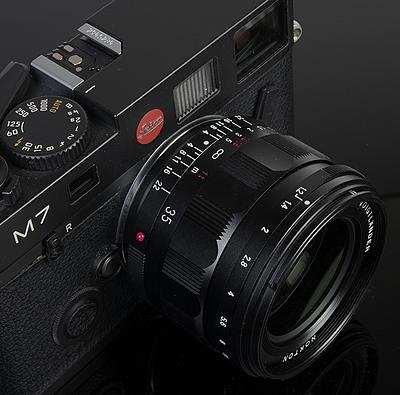
With the current atmosphere in the Leica community, largely dominated by the fever pitch surrounding the new 35mm Noctilux, I felt compelled to write up this short review of the Voigtlander 35mm f/1.2 IV.
Before we dive into the images, let’s clear the air. In the wake of the Leica 35mm Noctilux announcement, I’ve seen a wave of comments jumping to conclusions without having seen a single side by side comparison. To be absolutely clear, this is not a comparison between the Leica and the Voigtlander. I am not here to declare one better than the other or to crown a winner in a spec sheet war.
Instead, this is a re-evaluation of a modern classic. The Voigtlander 35mm f/1.2 Nokton has been a staple in the M mount world for years, and with the release of the Version 4 (IV), it’s time to look at it through a 2026 lens.
The goal of this review is to determine if its current rendering, its signature wide open character, and its mechanical integrity are good enough to play in the same arena as the newest flagship glass from Leica.
In fact, the only thing that can be determined as an absolute fact when comparing these two lenses right now is the price point. One carries a staggering five figure premium the other offers world class performance for a fraction of that.
I am not chasing the red dot or the luxury badge here, I am chasing the image. Every photo in this review was shot wide open at f/1.2 to see if this lens can still hold its own as a bokeh master in the modern era. If you’re here for the bling, you’re in the wrong place. If you’re here for the rendering, let’s begin.
With that said ....
The Leica world was recently set ablaze by the announcement of the Noctilux M 35mm f/1.2 ASPH. At a staggering $9,650.00, it represents the absolute pinnacle of Leica’s optical prestige, a dream lens by every definition. However, while the Noctilux will undoubtedly be an incredible piece of glass for those who can swing the investment, most of us live in a world where performance must be weighed against price.
Retailing for around $1,100.00, this lens sits at a fraction of the Leica's cost, yet it isn't playing for second place. The core of this review isn't about finding a budget alternative, it’s an exploration of a lens that is extremely well built, meticulously controlled and capable of producing exceptional contrast along with a beautiful rendering which is undenaibly a bokeh champion.
One point to address upfront, the spec sheet obsession with f/1.2 over f/1.4. In real world shooting, the difference in bokeh rendering between f/1.2 and f/1.4 is practically undiscernible. What truly matters and what I will focus on here, is the rendering and character this lens brings to the frame, proving that you don’t need to spend five figures to achieve a world class look.
I recently posted a review of the Zeiss ZM 35mm F1.4 Distagon
HERE where most people were critical about it's weight rather than performance. Having said that, keep the following in mind when looking at the Noctilux and the Nokton.
One of the most significant triumphs of the Voigtlander version 4 ( IV ) is its weight. At approximately 300g, the Version 4 has undergone a massive diet compared to its predecessors and even manages to undercut the new Leica Noctilux (416g). This weight reduction transforms the lens from a heavy specialty tool into a viable everyday carry. You get the light gathering power of a Noctilux class lens without the neck strain, making it arguably more practical for the rangefinder photographer. All thge Leica fanboys who complained about the Zeiss being heavy even though it produced better images than the Summilux FLE, remember what you said then. Because the same applie now to Voigtlander / Noctilux.
There is a common obsession in gear forums with the extra half stop of light. However, from a purely aesthetic standpoint, the difference in bokeh rendering between f/1.2 and f/1.4 is practically undiscernible to the naked eye. If you were to do a side by side blind test, most viewers would be unable to tell which frame had the slightly larger aperture.
To clarify the "f/1.4 vs. f/1.2" debate even further, the difference in bokeh is actually less discernable at close distances than it is at long distances.
At close range, when you are shooting at the minimum focus distance, the background is already a total wash. Whether you are at f/1.4 or f/1.2, the subject isolation is so extreme that the extra half stop provides no meaningful visual change.
At greater distances, it is only when your subject is further away, say, a full body portrait at 9 or 15 feet, that the slight increase in blur from an f/1.2 aperture becomes even remotely visible
Unless you are shooting wide open environmental portraits at a distance, chasing f/1.2 for the extra blur is a game of diminishing returns. The real reason to shoot this lens wide open isn't for a quantity of blur that you can't get at f/1.4, it’s for the specific rendering and character that this smooth operator brings to the entire frame.


I'd say the Voigtlander is much better in every respect than the Steel Rim. Particularly in suppression of fringing and contrast. Not as sharp nor as punchy as the 35 APO, a result I would have expected.
Overall I'd say the Voigtlander as an everyday fast 35 is indeed a keeper. I have tested the 35 Noctolux. A lovely lens however in my opinion not worth the extra money. I bought my 35 APO some time ago. The price is about $1500+ more now. I would not buy this lens at today's price.
Parenthetically I have owned the Zeiss 35 f1.4. That lens was not my favorite 35. Sharp, yes. But to me images seemed flat and lifeless. I used that lens on an M10 and M10R. On the M10 the best 35 I experienced was the little Zeiss 35 f2. Magic. On an M11 sadly the Zeiss 35 f2 didn't seem up to the the 60mp sensor.
None of this is scientific. Just my visual interpretation.