Search options
Cancel


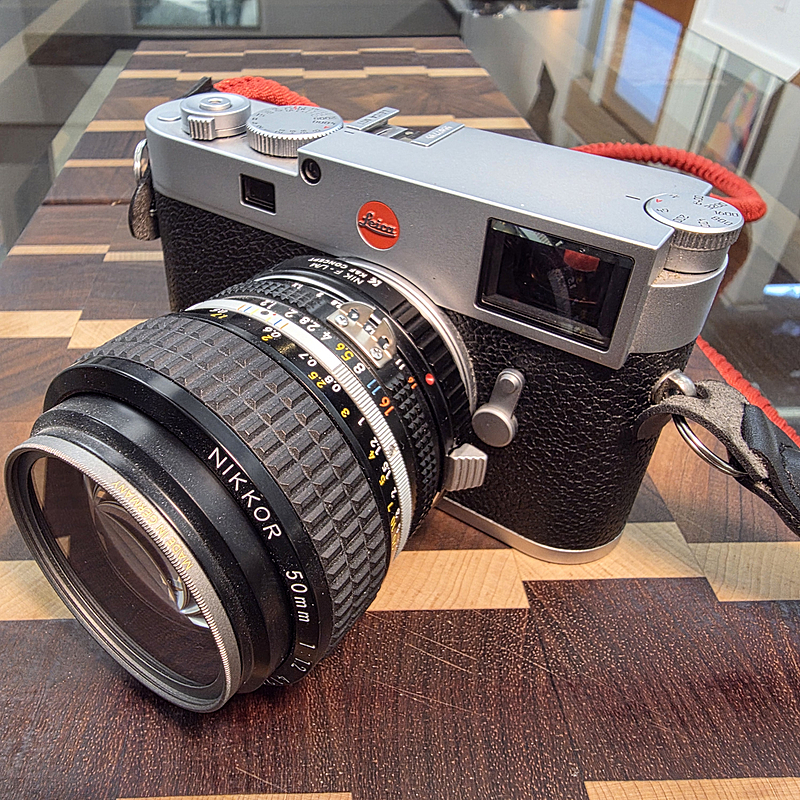 Bridging the Decades. Nikon Glass on Leica Silicon


Support PureRangefinder.com — Our community is free for everyone. If you value what we do, you can help cover our server and development costs with a small one time or monthly donation.


This first frame of Freya is the lens at its most unapologetic wide open at f/1.2. On a 60MP sensor like the M11, you can clearly see the lens's vintage design at work. It doesn't attempt to be a modern, clinical instrument, instead, it renders with a unique softness and a heavy spherical bloom that prioritizes feeling over clinical sharpness.
The transition from the focus to the out of focus areas is incredibly fast, creating a shallow depth of field that isolates her face while the rest of the frame fades away. You can see how the highlights on the blanket and her fur have a slight haloing effect, a signature of this specific Nikon optical formula that lends a classic, analog look to a high resolution digital file. It’s a perspective that captures the stillness of the moment, showing exactly what happens when you let a 40 year old lens dictate the aesthetic of a modern photograph.
Stepping down to f/2 completely changes the conversation. The glow we saw at f/1.2 pulls back, replaced by a sudden and dramatic increase in contrast and micro detail. This is widely considered the sweet spot for the 50mm 1.2 AIS, while the background remains smooth, Freya’s features now have more of a bite and definition that 60 megapixels demand. It’s the perfect balance for those who want vintage character without sacrificing the resolution the M11 is capable of delivering.
The transition from the monochromatic quiet of a nap to the vibrant world outdoors reveals the other side of this Nikon glass. In this frame, the color rendering takes center stage, working in tandem with the M11’s sensor to produce a palette that feels rich without being artificial.
At f/1.2, the dreamy quality isn't just a marketing buzzword, it’s a byproduct of how the lens handles light and depth. Notice the way the string lights in the background melt into soft, circular orbs and how the red of the door has a tempered saturation. There is a distinct wash over the image, a subtle loss of contrast typical of vintage fast glass, that softens the scene and gives it a film like quality.
It isn’t perfectly sharp, and the edges of high contrast objects have a slight chromatic fringing that modern lenses have spent decades trying to eliminate. But for this specific shot, those flaws are what make the image. It’s a rendering style that values the atmosphere of the afternoon light over clinical accuracy, proving that sometimes the best way to handle 60 megapixels is to take the edge off with a bit of classic Nikon spirit.
The shift from f/1.2 to f/2 is where the Nikon 50mm AIS truly finds its footing on a high res sensor. As soon as you click that aperture ring down, the glow and aberrations that defined the wide open shot practically vanish, replaced by a sudden and dramatic increase in detail.
In this f/2 version of the previous image, the image takes on a much punchier, modern character. Look at the decorative metalwork and the textures of the red door. The edges are now crisp and well defined, with a significant boost in global contrast. The colors appear more saturated and true as the lens is no longer struggling with the light leakage that characterizes its widest setting. While the background bokeh remains smooth and unobtrusive, the subject now has the biting sharpness required to actually utilize the M11's sensor potential. It is a night and day difference. By closing down just one stop, you move away from that heavy vintage character and into a look that actually feels modern and sharp.
This shot is a great example of how distance dictates the busyness of the background. At this range, the bokeh is relatively compressed; the streetlights and storefronts in the distance are rendered as smaller, more defined orbs of light. The fall off is gradual, letting your eye travel from the sharpest point of the bell down the length of the building.
When you move in closer to a subject with this lens, that compression completely shifts. The background elements don't just stay soft, they expand. The next image will show exactly how those distant light sources transform into much larger, overlapping circles when the physical distance between the lens and the subject is minimized.
Moving in closer to the bell transforms the background entirely. While the 1.2 rendering remains soft, the way the lens handles the out of focus elements changes as the magnification increases. By reducing the distance between the camera and the subject, those distant streetlights and reflections aren't just blurry anymore they expand into large, soft bokeh balls that dominate the background.
This closer perspective highlights the Nikon 50mm f/1.2 AIS's ability to completely isolate a subject. The background melts into a series of overlapping, luminous circles, creating a much more abstract feel than the previous wide shot. Even though the lens isn't delivering clinical sharpness here, the sheer volume of the bokeh provides a sense of depth that modern, slower lenses struggle to replicate. It shows that with vintage glass, the quality of the blur is often just as important as the sharpness of the subject itself.
Disclaimer or confession
It is worth noting that I often find the term "vintage" used as a lazy marketing excuse to mask the shortcomings of modern lenses that simply fail to meet today's performance expectations. However, in this specific case, the terminology is entirely earned. We aren't looking at a modern lens designed to mimic a classic look, we are dealing with a truly older, legacy Nikon optic. Because of that genuine heritage, the "glow" and character discussed here are legitimate physical traits of the glass rather than excuses for poor manufacturing.
At this aperture, the image is crisp and well defined, capturing the textures of the wooden bar and the clarity of the glassware without the heavy bloom seen at f/1.2. The lens provides a natural sense of depth, keeping the patron and his immediate surroundings in sharp focus while allowing the rest of the bar to fall into a smooth, unobtrusive blur. It’s a clean, realistic rendering that shows how this glass can be a reliable tool for everyday documentary style photography when you move just slightly past its widest setting.
In this scene, the focus was placed directly on the burlap textures in the center. At f/1.2, the depth of field is razor thin, causing the lamp in the foreground and the shelving in the back to dissolve into a smooth, dark blur. This isolation is particularly effective in a cluttered shop environment, as it allows you to pick out a single element and let the rest of the busy interior provide a sense of place without being a distraction.
The way the glass interacts with the warm, artificial shop lighting is also notable. You can see a gentle halo around the brightest parts of the lamp, which adds to that genuine vintage feel I have been discussing. It’s a specialized way of shooting that doesn’t rely on modern perfection but rather on how the lens can transform an everyday indoor corner into something with a distinct, timeless character.
Contrast. The hazy bloom around the lamp base and the burlap highlights has vanished, replaced by deep, clean shadows and much more vibrant tonal separation.
Detail. You can now clearly see the individual fibers and weave of the burlap, the lens is finally resolving the fine details that the M11's 60MP sensor is looking for.
Edge Sharpness. The focus point is sharp and clearly defined, allowing the subject to pop against the background without the distracting aberrations.
It is still a very smooth image, but the perverbial glow has been swapped for clarity.
Working with the cow carving at 1.2 shows the Nikon’s ability to handle fine, irregular textures under shop lighting. In the wide open shot, the focus is incredibly narrow, the cow's face and the milk bottle have a gentle, soft edged quality that blends smoothly into the surrounding blur. While the detail is there, it is wrapped in that familiar glow that softens the carving’s physical edges.
While the f/1.2 and f/2 comparisons highlight the lens’s character, stopping down further to f/5.6 shows what this glass can do when you ask it for maximum technical consistency. At this aperture, the 50mm f/1.2 AIS delivers a level of sharpness and clarity that is virtually indistinguishable from some of today's modern primes.
The entire frame, from the foreground to the distant signage, is rendered with a flat, even field of focus and high contrast. This shot demonstrates that while we often use this lens for its unique bokeh, it is still a highly capable tool for architectural or landscape work.
Even in an era dominated by clinical perfection and autofocus, the Nikon 50mm f/1.2 AIS remains a deeply relevant lens. There is a specific joy in using vintage glass that modern optics often lack, that tactile, mechanical experience that forces you to slow down and consider every frame.
While many photographers still consider this the standard on a classic Nikon film body, this dive into the 50 1.2 proves it holds its own on a demanding modern sensor.
The color rendering remains one of its greatest strengths. It delivers a rich colors that feels natural and avoids the artificial digital look common in some modern lenses. Whether you are chasing that wide open glow or stopping down to f/2 for sharp, punchy results, the lens offers a versatility that makes it a fascinating tool for the modern digital workflow.
Ultimately, this experiment shows that you don't always need the latest lens to get the most out of a modern sensor. Sometimes, the most interesting stories are told by reaching back into the archives and bringing a piece of heritage glass into the present .
The experience of shooting this setup is as much a part of the story as the images themselves. The K&F Concept F to M adapter provides a rock solid, all metal connection that feels appropriately industrial. There is no play or wobble, which is essential when you are wrestling with the heavy, knurled focus ring of a lens built like a tank.
If you have this lens, don't let it collect dust! Get out there and shoot with it!
You can view additional images taken with Nikon 50MM F1.2 AIS here OR here