Search options
Cancel


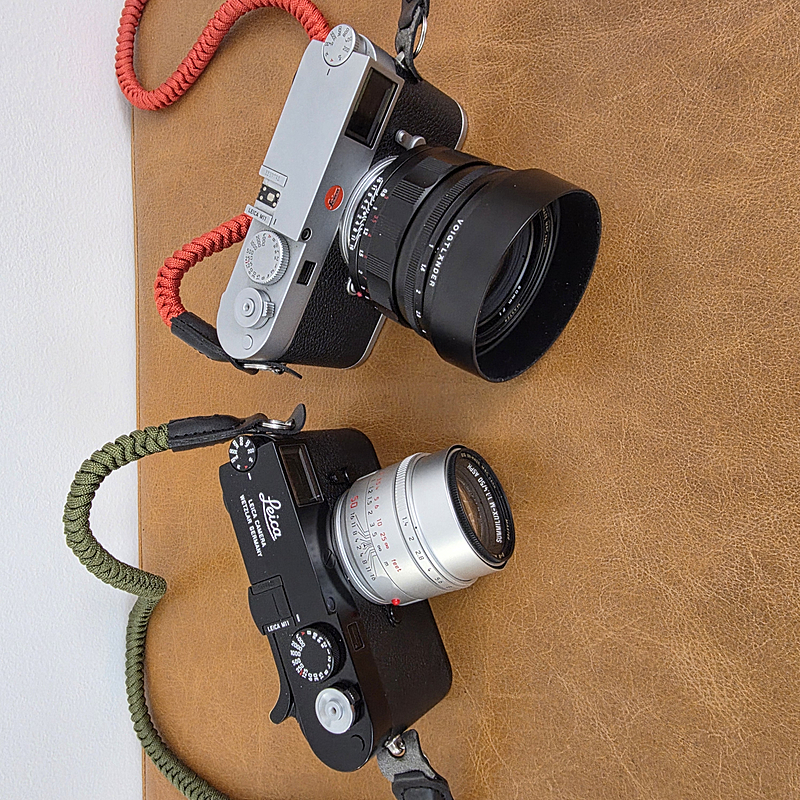 Can You Tell the Difference Between Leica and Voigtlander at f/1.4? Guest


Support PureRangefinder.com — Our community is free for everyone. If you value what we do, you can help cover our server and development costs with a small one time or monthly donation.


At f1.4, the center sharpness is pretty darn good. It retains that classic pop where the subject feels almost detached from the background.
The transition from focus to blur is aggressive. Even at 1.4, the Nokton with it's 12 blade diaphragm keeps the bokeh beautifully smooth.
The Summilux is designed to be flawless from 1.4. And it better be for what I paid for it. 💰 You get almost zero chromatic aberration and some may think it may be too sharp for portraits. For me, the sharper the better. I love to see those razor sharp eye lashes when i do a portrait shot. If I wanted soft, I would save the money and just buy a cheap lens.
What I like about the new lux is the .45m minimum focus distance. It allows me to see things from a different perspective that simply is not possible with the Voigtlander, which sits at the traditional .9m limit. Imagine the Nokton with this capabaility. Wow !! I gues I could use it with the Voigtlander close focus adapter on my Nikon ZF 😁
In this similar shot, the Summilux reveals why it is so desired. The rendering is exceptionally clean, with that clinical sharpness I like so much. Look at the fuzzy hairy stuff by the brakes.
However, lets not kid ourselves, the real story here is how well the Nokton holds its own at 1.4. While the Leica is built to be the benchmark standard, the Voigtlander is so crisp when stopped down that it becomes legitimately difficult for me to distinguish which lens is sharper.
Here, the Nokton, demonstrates why it is a favorite for those who love that unique rendering. Even stopped down to 1.4, the rendering remains distinctly organic.
Despite the reputation of the Leica Summilux, this shot proves that at 1.4, it is incredibly difficult for me to tell which lens is sharper. The detail resolved in the texture of the brass bells and the fine metal wires is impressive, showing that the Nokton is a sharp lens when you need it to be.
For me, the real magic here is the separation. While the Summilux offers a smooth, precise transition to blur and renders nicely, the Nokton provides a legendary 3D pop.
The out of focus areas are creamy and dreamlike, with the storefront and sign melting away.
The lens maintains excellent contrast even with the bright sky and reflected light in the background, ensuring the bells feel detached and multi dimensional.
With its 12 blade design, the out of focus highlights stay beautifully rounded, avoiding the more clinical look.
The texture of the brass is rendered with impressive clarity. The lens resolves fine details giving the subject a realistic quality.
What is most striking to me is that the sharpness here is so closely matched by the Nokton at 1.4 that once again, it becomes difficult to tell the difference. While the Leica might feel slightly crisper in its transitions, I truly believe the raw resolution between the two is essentially a dead heat.
NOTE: At 1.4, I give the bokeh advantage to the Summilux. Because the Summilux is being shot wide open, there are no aperture blades interfering with the light path, resulting in perfectly circular highlights. In contrast, since the Nokton is stopped down to f/1.4 from its maximum aperture of 1.0, the edges of the blades begin to emerge in the rendering. If the Nokton were shot wide open at 1.0, the bokeh balls would be just as smooth, but at f/1.4, the Summilux maintains the cleaner, more organic edge
I have used this particular subject in many previous reviews, but the Nokton managed something the other lenses didn't ( besides my Zeiss Distagon 1.4 ZM ) There is a remarkably clean separation and clarity in the barcode on that label that I haven't seen in prior tests. The lens isn't just delivering character, it is resolving fine, high contrast details with a level of precision that holds its own against the most clinical competitors.
The way the green metal of the trellis pops against the out of focus background lights reinforces that 3D quality I saw with the wind chimes. Even in a busy scene with strings of lights and glass reflections, the rendering remains orderly and the subject feels completely detached from the environment.
When placing this side by side with the Voigtlander shot at 1.4, it becomes a genuine challenge to pick a winner in raw resolution. As a reminder of my earlier statement on post processing, please keep in mind that while I have color corrected these images to my personal liking, we are looking specifically at the optical rendering here. While Leica carries a perfectionist expectation, the actual image shows that the two lenses are trading blows. Any perceived difference in sharpness is negligible, as both lenses resolve the fine details of the trellis and tag with nearly identical detail. Whether you prefer the final look of my color grade or the monochrome samples below the objective technical performance, the way the light is actually drawn by the lens is remarkably close between these two.
The only clear tell between these two shots lies in the background specular highlights, or bokeh balls.
Because the Summilux is shot wide open at f/1.4, the light path is completely unobstructed. The resulting bokeh balls are smooth, perfectly circular, and organic. Since the Nokton is stopped down from its maximum aperture of 1.0 to reach 1.4, the aperture blades are now physically present in the image path. If you look closely at the edges of the bokeh balls in the Nokton shot, you can see the subtle geometric influence of those blades.
Needless to say, if I had shot the Nokton wide open at f/1.0, those edges would disappear, and the bokeh would be just as smooth as the Leica's. However, at this specific aperture, the Summilux holds a slight edge in creaminess purely due to its physical state of being wide open.
Beyond that, the rendering, depth, and detail are so similar that picking one over the other based on resolution alone is nearly impossible for me. Both lenses are phenomenal performers that deliver a stunning result.
However, a direct comparison comes with a caveat. While the Nokton seems to take the lead here in terms of raw detail on the rope, I cannot be 100% convinced of a total victory. There is a possibility that the focus on the Summilux version below was slightly off, which can easily happen with the thin depth of field on the M system. Despite that uncertainty, this image remains a testament to the Nokton's ability to act as a precision tool that rivals the best glass when you nail the focus.
Beyond the sharpness of the rope, both lenses present the out of focus areas with a beautiful smoothness that makes a definitive choice nearly impossible for me. The background melt in both samples is painterly, isolating the subject without any harsh nervous edges. That said, I would give a slight edge to the Nokton in this specific instance, there is a certain effortless quality to how it handles the deep background transitions that feels just a touch smoother.
Both lenses handle the out of focus background with a smooth, melt away feel that makes subject stand out without any harsh edges. Once again, for me, choosing between the two is a difficult task. I leave it up to you to decide which rendering is more pleasing to your eye.
And here are just a few Black & White samples. Nothing special, but something to show besides the close up images we have been dissecting.
By placing the subject behind a foreground of stacked plates and dishes, you can see how the lens handles out of focus layers. The transition from the soft, blurred shapes in the front to the sharp, focused detail of the chef's face is handled smoothly. This creates a sense of 3D that isn't dependent on color contrast, but rather on how the lens physically draws the light.
As I’ve noted throughout this article, the post processing here is entirely personal, but in a Black & White frame like this, that point becomes even more salient. I am forced to look at the actual rendering, the detail of the hat, the clarity in the eyes, and the way the background highlights fall away. At f/2, the Nokton really shows its strength and capabilities proving that its remains consistent and compelling long after the color is removed from the image.
The Black & White rendering is particularly effective here, as it allows you to appreciate the tonal range and the lens's ability to maintain a clear sense of depth. Despite the numerous elements from the stainless steel equipment to the various kitchen tools, the subject remains naturally separated from the environment.
This image is less about being artsy fartsy and more about the Nokton’s capability as a reliable lens. It proves that even in a chaotic, poorly lit workspace, the lens can deliver a sharp rendered image that holds up. Not bad for a lens 3x less expensive than the Summilux.
In the end, as a longtime Leica user myself, I have to admit that sometimes it’s difficult to accept the facts for what they are. My pride and perhaps the investment I made into the red dot can sometimes blind my view of reality. Do you feel the same way? Really. Do you and just don't admit it?
In this case, just because I may own the Summilux, I cannot simply and blatantly say it is "so much better" than anything else. The reality is that there are many options out there that give it a serious challenge, and the data from these samples proves it. At least to me it does.
Ultimately, these two lenses represent a fascinating paradox, they are drastically different in their physical design and specifications, yet remarkably similar in their real world performance. Throughout this comparison, I have seen how they trade blows in resolution and rendering, often to the point where it becomes a genuine challenge to pick a winner. Neither lens is objectively better than the other. Instead, they offer different paths to the same expected result. In almost any shooting scenario, either of these lenses could easily replace the other without sacrificing the quality expected of them.
The choice, then, comes down to your specific priorities as a shooter
From the Nokton, you get a significant price to performance lead, offering F1.0 capabilities and world class sharpness at a fraction of the Leica's cost. However, the Summilux offers a compact form factor that defines the rangefinder experience, providing a size advantage that makes it a much more discrete and portable daily companion.
Whether you value the extreme light gathering potential and value of the Voigtlander or the iconic portability of the Leica, regardless of your choice, you are getting a lens that delivers a beautiful, sophisticated rendering.
Let us know what you think. Provide your feedback HERE