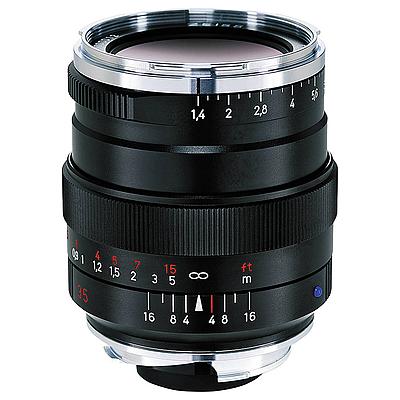
The Zeiss 35mm f/1.4 ZM. The Undisputed King of the M11 Sensor
As you may know, I am a lover of the 50mm focal length and that is what I mainly shoot with. However, after needing to use a 35 the other day, I grabbed my trusty Zeiss 35 Distagon ZM. After seeing the results it produced, I felt compelled to write about it and why I still think it's the best 35 for the M system.
We all know there is a pervasive myth that the most expensive glass from Leica represents the undisputed ceiling of performance. For years, the Leica 35mm Summilux f/1.4 FLE has been touted as the benchmark. However, I believe there is a titan in the field that has quietly refused to cede its throne. Yea, I know, I am a Zeiss fanboy. But for a reason.
You don't have to take my word for it, a quick scan of the industry's most respected gearheads reveals a consistent consensus. From technical specialists to seasoned street photographers, the community has leaned heavily toward the Zeiss in head to head comparisons. The Zeiss may not be the newest kid on the block, but when paired with an M11, it proves that modern and superior are not always synonyms. In fact, the results I captured here highlight a level of clarity, bokeh, and contrast that in my opinion cements its status as the undisputed king of 35s.
I will not spend time on MTF charts or academic data. This review is focused purely on real world results. In the Leica community, the Summilux 35mm FLE is often described as having soul, which is usually just code for optical flaws that happen to look nice. It’s important to be honest here especially with ourselves, terms like "vintage," "glow," and "soul" are far too often used to justify a massive price tag or mask a lens's inability to resolve a modern sensor. The Zeiss 35 refuses to hide behind such terminology. It simply delivers!
As mentioned above, while there are plenty of existing resources comparing these two lenses side by side, this review is intentionally focused on the merits of the Zeiss. Rather than a back and forth comparison, the I present you with are dedicated to showcasing the specific rendering and excellence of the Distagon, allowing its performance to speak for itself.
Why the Distagon sets the Gold Standard? The Distagon design is famous for its aggressive micro contrast. It doesn't just record shapes, it renders textures and depth with quality that makes the image feel three dimensional. Unlike the Summilux FLE, the Zeiss is known for a remarkably flat field across the frame. This ensures that sharpness remains consistent from edge to edge, avoiding the resolution dips often found in compact Leica designs. Also, the Zeiss handles high contrast edges with more grace than the non APO Summilux. Where the Leica might show blooming or fringing in harsh light, the Distagon remains clean and biting.
While the sharpness is undeniably crazy, the transition to out of focus areas is buttery, providing a medium format look that the Leica struggle to replicate.
Keep in mind, these are my personal views on the lens. I understand that others will disagree. But I am just letting you know what I think about this awesome lens!
Perhaps most importantly, you are receiving superior optical performance for roughly half the price of the Leica equivalent. For me, this isn’t just a review, it’s a re evaluation of a classic 35 that, even in 2026, I believe still sets the standard for what a 35mm lens can achieve.
Critics often point to the Zeiss 35mm f/1.4 ZM’s physical size as a drawback, but one look at a landscape file from the Leica M11 renders that argument moot. While other reviews offer endless side y-side comparisons, the image quality here speaks for itself, showcasing a level of performance that clearly puts the Zeiss at the top of the hierarchy.
In this shot at f/5.6, the empty blue sky actually highlights the lens's greatest strength, absolute transparency. Without clouds to hide behind, the Distagon shows off its perfectly flat field of focus and aggressive micro contrast. The rendering provides a sense of depth and clarity that makes the 60MP sensor truly earn its keep.
Instead of the glow often praised in other lenses which, as I have noted, is frequently a mask for softness, the Zeiss delivers a clarity that is simply unmatched.
Despite the harsh, direct overhead lighting, look at the transition between the dark evergreens. The Zeiss doesn't just record these as colors, it records them as textures. This lens extracts a level of detail from the foliage that makes the landscape feel like you could reachout and touch it. This is the king of 35s in action, delivering a 3D pop that provides a weight to the image that softer, more so called romantic lenses simply cannot replicate.
Notice the horizon line against the cloudless blue. A lesser lens would show slight smearing or chromatic aberration where the dark trees meet the bright sky. Here, the line is incredibly clean. There is zero purple fringing or blooming, a testament to the Distagon’s superior color correction. The deep, rich blue is a signature of the Zeiss T* coating, which cuts through haze and saturates tones more naturally than the competition.
Even at f/5.6 in the extreme bottom corners the focus remains tack sharp. While many 35mm lenses suffer from field curvature where center sharpness comes at the expense of the corners, this shot proves the Distagon’s plane of focus is perfectly flat. Your eye can wander from the immediate foreground to the distant mountains without ever hitting a soft patch.
If you zoom into the far background mountains, the M11/Zeiss combo is still resolving individual tree lines and rock faces. At f/5.6, we have reached the diffraction limited sweet spot. It proves that this optical design wasn't just good for its time, it was clearly over engineered with future high megapixel sensors in mind.
Note: Although this image has been cropped from the top and bottom for composition, it retains 100% of the frame from left to right, allowing you to see the flawless performance all the way to the edges.
If the landscape shots prove the Distagon’s consistency, its non landscape performance is nothing short of uncompromising image quality. Looking at the facial details on my wife, every pore and fine line is rendered with a staggering level of honesty. She doesn't know I posted this so don't tell her. As mentioned above, while many other reviews spend time on side by side comparisons, the single lens results shown here make a definitive case for the Zeiss.
The real triumph is found in the hair where other lenses might smudge fine textures into a unified shape, the 35 ZM clearly resolves individual strands. This is a key area where it asserts its dominance over the Leica 35mm and other lenses.
One of the most striking aspects of this lens is its color science. While Leica glass is often celebrated for its warmth, the Zeiss provides a lifelike neutrality that serves as a superior starting point. It offers a clean slate that allows the sensor's full dynamic range to shine without artificial tinting.
But the real magic lies in the separation. Even at f/5.6, an aperture where most lenses start to flatten the image the Distagon maintains its legendary 3D Pop. By prioritizing contrast over simple, blurry bokeh, it carves the subject out of the frame.
Because of the lens's technical superiority, you don’t just see the texture of the hair and skin, you feel the physical distance between the subject and the world behind them. It is this specific combination of clarity and depth that justifies the Zeiss's title as the undisputed king of 35s.
This image showcases the Zeiss 35mm f/1.4 Distagon ZM’s character, particularly its ability to render a complex scene with smooth transitions and sharp focus.
At f/1.4, the bokeh is creamy and painterly. There is no denying it. This lens simply rocks! The background light sources are transformed into soft, circular orbs that retain a gentle structure without becoming distracting. There is a slight cat eye effect toward the edges of the frame, which in my opinion is a good thing. It adds a classic, cinematic swirl to the out of focus cafe seating and greenery in the background. The fall off from the sharp foreground globe to the blurred street scene is rapid but creates a deep sense of three dimensionality.
The detail captured along the edge of the black fabric, the piping or seam running up from the globe is impressive for such a wide aperture. Despite the incredibly thin depth of field.
The Distagon simply excels here, showing a crisp definition between the dark fabric and the blurred yellow architectural element behind it.
The contrast between the gritty, illustrated heart on the globe and the glowing background makes for a very compelling shot.
For the black and white enthusiast, the Distagon is a revelation. While many photographers hunt for vintage glass to get 'soul in their monochrome files, the Distagon offers something arguably more valuable, tonal transparency. Thanks to its exceptional contrast, the lens renders a rich spectrum of grays that most modern optics compress. Even when lighting is flat, the lens's ability to resolve fine textures gives the image a visceral, three dimensional presence. On the M11, this results in B&W files that are sharp yet possess a classic look.
While the above image shows that classic look, this image demonstrates that the Distagon can deliver a strikingly modern monochrome. By utilizing DxO PhotoLab to harness the M11's raw dynamic range, the Zeiss glass provides the contrast necessary to make a scene feel electric. It trades the glow of your traditional lenses for a transparent, high fidelity realism where every pine needle and snowflake is accounted for. It is proof that in 2026, this older lens is still the most capable tool for those who want their black and white photography to feel immediate and alive.
Keep in mind, you are viewing a scaled down version of the full image for presentation here. The full res image clearly show the detail.
While the Summilux FLE is often praised for its character, it can sometimes produce nervous or soap bubble bokeh (where the edges of out of focus highlights are bright and distracting). This photo captures the Zeiss doing the exact opposite, reinforcing why it remains the superior choice for those who prioritize actual performance.
Shot wide open at f/1.4 on the M11, the bokeh is reminiscent of a medium format render, creamy, effortless, and entirely devoid of the "soap bubble" nervousness found in Leica’s equivalent. But don’t mistake this smoothness for softness. The subject separation is achieved through a radical level of wide open sharpness and neutral colors that feels modern and transparent. The Distagon doesn't just blur the background, it creates a 3D stage for the subject to live in, proving once again why it is the undisputed king of 35s.
While all images in this review were refined using DxO PhotoLab to ensure peak optical correction, the color comes directly from the glass. Zeiss utilizes its T *coating to deliver a level of color purity that is, in many ways, more honest than the competition. It avoids the warm bias of Leica glass, instead offering a neutral, high contrast canvas. On the M11, this results in incredible subject separation. Again, I ahte to use this word so often. But, the contrast is so high that even at f/2, the files possess a quality where colors feel separated by depth, not just hue.
Looking at these buoy shots, the argument for the Zeiss over any competition becomes undeniable. The sharpness isn't just about resolution. The clarity of the rendering are key as well. Processed through DxO PhotoLab, the files reveal a lens that is essentially perfect. The way it handles the texture of weathered rope and flaking paint while maintaining a deep, saturated color palette again shows that this old lens was actually built for the future sensors.
Using DxO Photo Lab 9 to ensure peak optical correction, the color comes directly from the glass. Zeiss utilizes its T *coating to deliver a level of color purity that is, in many ways, more honest than the competition. It avoids the warm bias of Leica glass, instead offering a neutral, high contrast canvas.
On the M11, this results in incredible subject separation. Again, I hate to use this word so often. But, the contrast is so high that even at f/2, the files possess a quality where colors feel separated by depth, not just hue
In this series of monochrome captures, the Distagon demonstrates that it doesn’t need the latest sensor or a dedicated monochrome body to deliver impressive results.These images provide a compelling argument for the flexibility of color to monochrome conversion and the inherent superiority of Zeiss’s rendering over a monchrome camera.
By starting with a color file, I have the ability to manipulate color channels during the B&W conversion in DxO PhotoLab. This allows me to lighten or darken specific tones like the skin in the bar scene or the separation in the office portrait with a level of precision a monochrome sensor simply cannot offer.
Even on the M10, the nature of the Distagon is on full display.
In the office portrait and the bar scene I posted, look at the rendering of fabric and hair. The lens avoids the smearing often seen in lenses like a Summilux, instead resolving individual fibers and strands with incredible clarity.
Where the Summilux is known to rely on a glow that can soften fine details in B&W, the Zeiss provides tonal transparency. The images appear better because they possess an integrity that makes the subjects feel more three dimensional.
The Zeiss Pop is particularly evident in these greyscale files. The lens manages to find separation between very similar shades of grey, creating a depth that feels sophisticated and expensive.
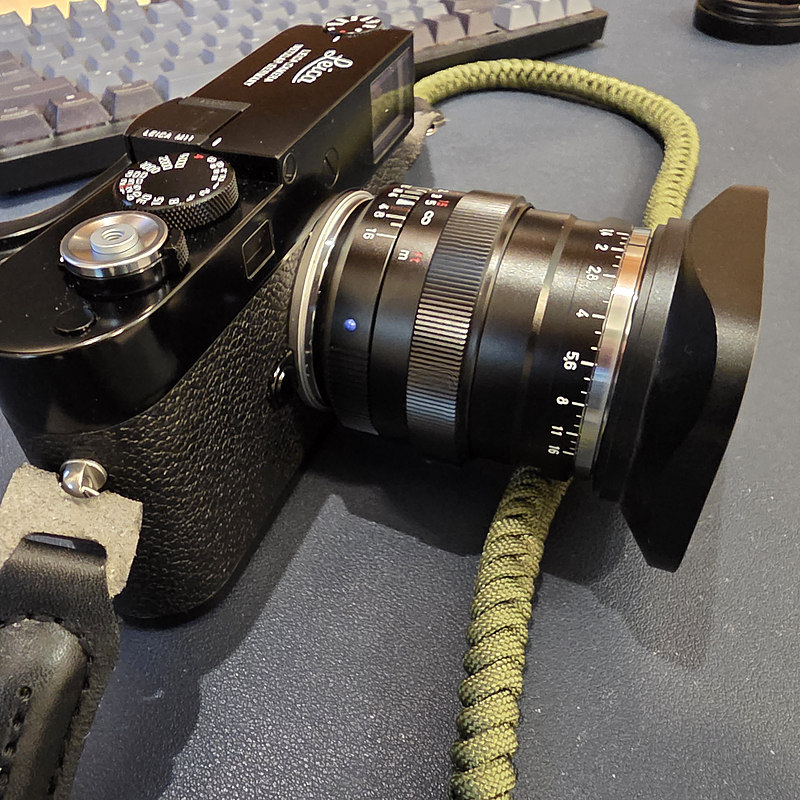
As I mentioned before, complaining about the size of the Zeiss 35mm f/1.4 ZM Distagon is a moot point. While it is undeniably larger than the Leica Summilux FLE, the proof is in the files. The lens just works. It doesn't ask for compromises in the corners or wide open performance; it simply delivers a perfect frame every time you hit the shutter.
On a body like the M10 or M11, the extra bulk which in this case is minimal is a small price to pay for the medium format rendering and clarity it provides.
In these candid scenes, the Zeiss Distagon truly separates itself from the competition.
In this bustling kitchen shot, the lens maintains incredible focus on the chef’s expression despite the high contrast environment. The textures of the stainless steel, the steam, and the fabric of his shirt are resolved with an acuance that makes the scene feel immediate and alive.
The bar scene just above, highlights the lens’s ability to handle flat or difficult lighting. There is a rich spectrum of grays that most modern lenses would compress into a muddy mess. Instead, what I see is a distinct separation between the, patrons, the bartender, and the background bottles.
These images prove that the Zeiss 35mm ZM is not just a landscape lens, it is a street and portrait powerhouse. By utilizing the M10's color data for our monochrome conversions, we achieve a look that is both modern and classic. The Distagon swaps the 'nervous' rendering of the Summilux for a three dimensional stage. At the end of the day, the lens’s size is irrelevant when it produces images of this caliber. It is quite simply the best 35mm glass you can put on a rangefinder.
The final piece of the puzzle lies in these quasi portrait samples. While I am neither a professional portrait photographer nor a studio specialist, these captures on both the M10 and M11 serve a critical purpose, they demonstrate the unrivaled optical capabilities of the Z35 Distagon in real world, candid scenarios.
In these shots ranging from the office setting to the dimly lit bar, the Distagon proves that character doesn't have to mean softness.
Even in the office portrait of my coworker with glasses, the lens's signature micro contrast is on full display. Again, the texture of the facial hair and the subtle reflections in the eyewear are rendered with a clarity that makes the subject feel tangible.
Even without a studio setup, these images possess a medium format weight. The transition from the sharpest point of the eye to the gentle fall off of the background is liquid smooth. It creates a stage for the subject to live in, rather than just a flat image.
This series of images from the vibrancy of the buoys to the gritty, textured depth of the monochrome interiors leads to one undeniable conclusion. While the Leica 35mm Summilux FLE is undoubtedly a masterpiece of compact engineering, the Zeiss 35mm f/1.4 ZM is a masterpiece of pure optics. It reigns supreme above all. I bet it will even give the new 35 Noctilux a run for it's money. But I cannot afford that lens now for testing.
As I have stated, the industry’s most respected gearheads have long leaned toward the Zeiss in their evaluations, and the results captured on the M11’s 60MP sensor today only confirm their findings. While others may cling to the Leica for its soul or glow terms I recognize as masks for softness and optical compromise, the Zeiss offers something far more valuable, the unfiltered optical quality.
If you value the full potential of your sensor and demand a lens that renders with surgical precision, legendary 3D pop, and uncompromising fidelity, the Zeiss remains unrivaled. It is a rare optical achievement that wasn’t just built for its time, but clearly over engineered for the future. Even in 2026, the Distagon doesn't just keep up with the competition it dictates the standard.
Browse the followmg links for more images taken with the Zeiss 35mm 1.4 ZM Distagon
A late addition to this review. I stumbled onto a great deal for a Summilux 35mm FLE, and I’ll admit, it was tempting. Really tempting. But before pulling the trigger, I took the Distagon out for a walk today and snapped a few frames around town. That was all it took to remind me why I love this lens and will never find a replacement for it.
This last image is posted at pretty high res so you can better appreciate the capabilities of the Distagon.
Use formatting shortcuts: [b]bold[/b], [i]italics[/i], [quote]quote[/quote], or [url=https://site.com]links[/url]. Paste a direct photo URL (.jpg, .png, .webp) or video link to embed it instantly.
I agree with everything you said except for the size. I still cant use this lens because it's so large and front heavy on an M.
I too would rather have the lens be smaller. But for me, I live with it because of the results.
Guest
06-05-26 17:50
I agree with everything you said except for the size. I still cant use this lens because it's so large and front heavy on an M.
Hide conversation
Get your store banner on PureRangefinder.com Send us an email to support@purerangefinder.com
Support PureRangefinder.com — Our community is free for everyone. If you value what we do, you can help cover our server and development costs with a small one time or monthly donation.




In this shot at f/5.6, the empty blue sky actually highlights the lens's greatest strength, absolute transparency. Without clouds to hide behind, the Distagon shows off its perfectly flat field of focus and aggressive micro contrast. The rendering provides a sense of depth and clarity that makes the 60MP sensor truly earn its keep.
Instead of the glow often praised in other lenses which, as I have noted, is frequently a mask for softness, the Zeiss delivers a clarity that is simply unmatched.
Despite the harsh, direct overhead lighting, look at the transition between the dark evergreens. The Zeiss doesn't just record these as colors, it records them as textures. This lens extracts a level of detail from the foliage that makes the landscape feel like you could reachout and touch it. This is the king of 35s in action, delivering a 3D pop that provides a weight to the image that softer, more so called romantic lenses simply cannot replicate.
Notice the horizon line against the cloudless blue. A lesser lens would show slight smearing or chromatic aberration where the dark trees meet the bright sky. Here, the line is incredibly clean. There is zero purple fringing or blooming, a testament to the Distagon’s superior color correction. The deep, rich blue is a signature of the Zeiss T* coating, which cuts through haze and saturates tones more naturally than the competition.
Even at f/5.6 in the extreme bottom corners the focus remains tack sharp. While many 35mm lenses suffer from field curvature where center sharpness comes at the expense of the corners, this shot proves the Distagon’s plane of focus is perfectly flat. Your eye can wander from the immediate foreground to the distant mountains without ever hitting a soft patch.
If you zoom into the far background mountains, the M11/Zeiss combo is still resolving individual tree lines and rock faces. At f/5.6, we have reached the diffraction limited sweet spot. It proves that this optical design wasn't just good for its time, it was clearly over engineered with future high megapixel sensors in mind.
Note: Although this image has been cropped from the top and bottom for composition, it retains 100% of the frame from left to right, allowing you to see the flawless performance all the way to the edges.
The real triumph is found in the hair where other lenses might smudge fine textures into a unified shape, the 35 ZM clearly resolves individual strands. This is a key area where it asserts its dominance over the Leica 35mm and other lenses.
One of the most striking aspects of this lens is its color science. While Leica glass is often celebrated for its warmth, the Zeiss provides a lifelike neutrality that serves as a superior starting point. It offers a clean slate that allows the sensor's full dynamic range to shine without artificial tinting.
But the real magic lies in the separation. Even at f/5.6, an aperture where most lenses start to flatten the image the Distagon maintains its legendary 3D Pop. By prioritizing contrast over simple, blurry bokeh, it carves the subject out of the frame.
Because of the lens's technical superiority, you don’t just see the texture of the hair and skin, you feel the physical distance between the subject and the world behind them. It is this specific combination of clarity and depth that justifies the Zeiss's title as the undisputed king of 35s.
At f/1.4, the bokeh is creamy and painterly. There is no denying it. This lens simply rocks! The background light sources are transformed into soft, circular orbs that retain a gentle structure without becoming distracting. There is a slight cat eye effect toward the edges of the frame, which in my opinion is a good thing. It adds a classic, cinematic swirl to the out of focus cafe seating and greenery in the background. The fall off from the sharp foreground globe to the blurred street scene is rapid but creates a deep sense of three dimensionality.
The detail captured along the edge of the black fabric, the piping or seam running up from the globe is impressive for such a wide aperture. Despite the incredibly thin depth of field.
The Distagon simply excels here, showing a crisp definition between the dark fabric and the blurred yellow architectural element behind it.
The contrast between the gritty, illustrated heart on the globe and the glowing background makes for a very compelling shot.
God, I love this lens!
Keep in mind, you are viewing a scaled down version of the full image for presentation here. The full res image clearly show the detail.
Shot wide open at f/1.4 on the M11, the bokeh is reminiscent of a medium format render, creamy, effortless, and entirely devoid of the "soap bubble" nervousness found in Leica’s equivalent. But don’t mistake this smoothness for softness. The subject separation is achieved through a radical level of wide open sharpness and neutral colors that feels modern and transparent. The Distagon doesn't just blur the background, it creates a 3D stage for the subject to live in, proving once again why it is the undisputed king of 35s.
👑
By starting with a color file, I have the ability to manipulate color channels during the B&W conversion in DxO PhotoLab. This allows me to lighten or darken specific tones like the skin in the bar scene or the separation in the office portrait with a level of precision a monochrome sensor simply cannot offer.
Even on the M10, the nature of the Distagon is on full display.
In the office portrait and the bar scene I posted, look at the rendering of fabric and hair. The lens avoids the smearing often seen in lenses like a Summilux, instead resolving individual fibers and strands with incredible clarity.
Where the Summilux is known to rely on a glow that can soften fine details in B&W, the Zeiss provides tonal transparency. The images appear better because they possess an integrity that makes the subjects feel more three dimensional.
The Zeiss Pop is particularly evident in these greyscale files. The lens manages to find separation between very similar shades of grey, creating a depth that feels sophisticated and expensive.
On a body like the M10 or M11, the extra bulk which in this case is minimal is a small price to pay for the medium format rendering and clarity it provides.
In these candid scenes, the Zeiss Distagon truly separates itself from the competition.
In this bustling kitchen shot, the lens maintains incredible focus on the chef’s expression despite the high contrast environment. The textures of the stainless steel, the steam, and the fabric of his shirt are resolved with an acuance that makes the scene feel immediate and alive.
The bar scene just above, highlights the lens’s ability to handle flat or difficult lighting. There is a rich spectrum of grays that most modern lenses would compress into a muddy mess. Instead, what I see is a distinct separation between the, patrons, the bartender, and the background bottles.
These images prove that the Zeiss 35mm ZM is not just a landscape lens, it is a street and portrait powerhouse. By utilizing the M10's color data for our monochrome conversions, we achieve a look that is both modern and classic. The Distagon swaps the 'nervous' rendering of the Summilux for a three dimensional stage. At the end of the day, the lens’s size is irrelevant when it produces images of this caliber. It is quite simply the best 35mm glass you can put on a rangefinder.
In these shots ranging from the office setting to the dimly lit bar, the Distagon proves that character doesn't have to mean softness.
Even in the office portrait of my coworker with glasses, the lens's signature micro contrast is on full display. Again, the texture of the facial hair and the subtle reflections in the eyewear are rendered with a clarity that makes the subject feel tangible.
Even without a studio setup, these images possess a medium format weight. The transition from the sharpest point of the eye to the gentle fall off of the background is liquid smooth. It creates a stage for the subject to live in, rather than just a flat image.
As I have stated, the industry’s most respected gearheads have long leaned toward the Zeiss in their evaluations, and the results captured on the M11’s 60MP sensor today only confirm their findings. While others may cling to the Leica for its soul or glow terms I recognize as masks for softness and optical compromise, the Zeiss offers something far more valuable, the unfiltered optical quality.
If you value the full potential of your sensor and demand a lens that renders with surgical precision, legendary 3D pop, and uncompromising fidelity, the Zeiss remains unrivaled. It is a rare optical achievement that wasn’t just built for its time, but clearly over engineered for the future. Even in 2026, the Distagon doesn't just keep up with the competition it dictates the standard.
Browse the followmg links for more images taken with the Zeiss 35mm 1.4 ZM Distagon
From PreRangefinder.com
From ZeissImages.com
From LeicaImages.com
Provide your feedback
This last image is posted at pretty high res so you can better appreciate the capabilities of the Distagon.